
Site Plan Review Steps That Support Approvals
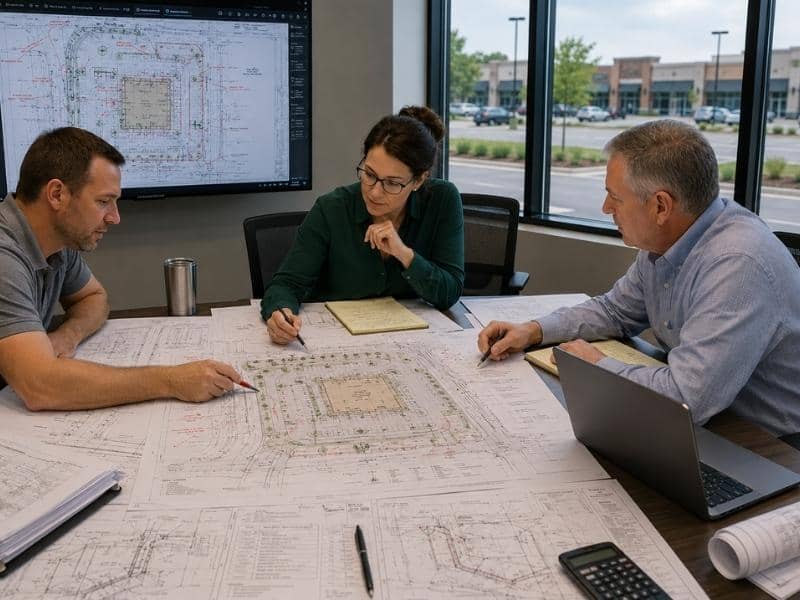
Few things test an owner’s patience like waiting on a site plan. The review process has a name for being slow. Part of that name is earned. The rest comes from people who send in weak drawings and then blame the agency for the delay. Reviewers work from a set list of things they expect to see. A plan that meets that list moves much faster than one that does not. The gap shows up months before anyone reaches the counter.
Preparing a Site Plan That Meets Review Expectations
Reviewers open a plan looking for certain things. Where the building sits. How far it stands from each property line. How cars come in and move around. How many parking spaces the use needs. Where water goes. How the site ties into public utilities. What plants the code calls for. A drawing that answers all of that in a clear way earns a fair reading.
Looks matter more than most people expect. Clear text, the right scale, a north arrow, and a clean legend sound like small things. But a reviewer working through a tall stack notices them right away. A messy drawing hints at messy design. That first thought colors every comment that comes after.
Coordinating Technical Disciplines Before Submission
A site plan pulls from many hands at once. The surveyor shows what is already there. The architect sets the building shape. The civil engineer handles grading, drainage, and utilities. The landscape designer fills the space between. All of these parts must agree before anything is sent in.
Conflicts hide in the seams. A power pad drawn where the plan shows a tree. A storm line running through a planned foundation. A parking count that changed when the building grew, but no one fixed the total. Reviewers spot these clashes fast and send the whole set back. A check between teams takes a week in house. The same clash found by an agency costs a full review cycle.
Responding Efficiently to Review Comments
Comments come on almost every project. Getting them says nothing about the quality of the work. How an applicant answers them says a lot. The smart way treats each comment as a question that needs a clear answer. Fix it on the drawing. Then confirm it in a short written reply that points to where the change is.
Trouble starts when applicants argue instead of fix. Or when they fix four comments out of six and hope no one checks. Reviewers always check. A partial answer buys another round, and each round burns weeks. If you disagree with a comment, call and talk it through. That works far better than sending the same plan back unchanged.
Balancing Site Function With Regulatory Requirements
Codes give minimums. A plan built to just those minimums often works poorly in real life. An aisle wide enough for the rule can still trap a delivery truck. A dumpster tucked in the legal corner can force the hauler to back across the whole lot.
Good design meets the rule and the daily reality at once. Where the two pull apart, you have choices. Change the layout. Ask for a waiver with a solid reason. Or accept a tradeoff on purpose, not by accident. The plans that age well are the ones where someone asked how the site would really work on a plain Tuesday. Then they designed around the answer.
Maintaining Project Momentum After Site Plan Approval
Approval is a checkpoint, not a finish line. The approved plan then grows into build documents that guide the next phase of site development. Separate permits follow for grading, utility hookups, and stormwater work. Each one has its own review process and timeline.
Conditions tied to the approval need tracking too. Agencies often want an easement, a fee, or a bond before work starts. Missing one of those can quietly stall a project everyone thought was cleared. Owners who put someone in charge of that list keep moving. Owners who assume approval settled it all often find out otherwise at the worst time.
Frequently Asked Questions
What information should be included in a site plan?
Building placement with setback sizes, parking layout and counts, entry points and inside traffic flow, grading and drainage, utility hookups, landscaping, lighting, and what is already on the site. Rules change by place and by project type, so the local checklist rules. Anything a reviewer has to hunt for turns into a comment.
Why do agencies request revisions during a site plan review?
Usually because something is missing, unclear, or does not match between sheets. Reviewers check the plan against the code and against itself. Any gap becomes a written comment. Some changes point to a real design conflict. But a large share come from facts the applicant just never gave.
How can a complete site plan help speed up project approvals?
A complete plan removes the reason for extra rounds. A reviewer who finds every needed item can approve or comment for real on the first pass. They do not have to send the set back for basic gaps. Since each cycle often adds several weeks, cutting even one round makes the schedule much shorter.