
Detention Pond Design Near Property Boundaries
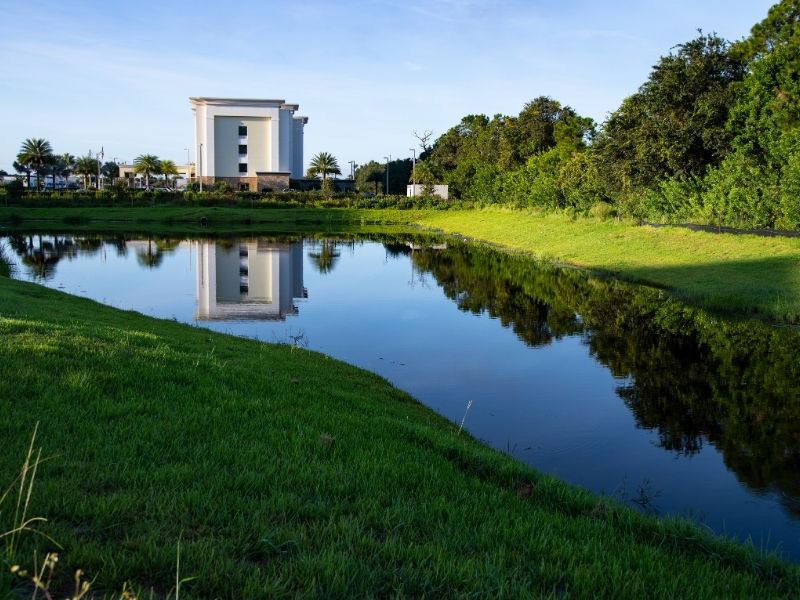
A detention pond can meet every volume calculation and still cause problems if it sits too close to a neighbor’s land. Water that seeps through a berm, spills over a weak outlet, or erodes a steep side slope doesn’t stop at the property line. For developers and site engineers, good detention pond design near boundaries means planning for the adjacent parcel as carefully as the pond itself. The checks below should happen before the grading plan is finalized.
How Property Boundaries Affect Detention Pond Placement
Property boundaries often decide where a detention pond can go before any hydrology work begins. Many jurisdictions set minimum setbacks between stormwater facilities and lot lines, though the exact distance depends on local code and the type of pond. Easements, utility corridors, and buffer requirements can shrink the usable area even further. That’s why a current boundary survey and title review should come first.
On tight lots, the pond usually ends up against the property line because that’s the low corner of the site. Gravity makes the location tempting, but it also puts the pond’s most vulnerable features next to someone else’s land. The design team should weigh whether a deeper pond with a smaller footprint, an underground system, or a split facility would fit better. Each option affects cost, maintenance, and how much buffer stays between the water and the neighbor.
Evaluating Site Grading, Soil Conditions, and Drainage Patterns
A pond near a boundary has to fit the site’s existing grading and drainage. Start by mapping where runoff enters and leaves the property today. A topographic survey shows the natural flow paths, low spots, and any off-site water that already crosses the line. Many review agencies expect post-development discharge to stay close to existing conditions, so this baseline matters.
Soil conditions shape almost every design choice. Sandy soils may drain quickly but can erode or carry water under a berm. Clay soils hold water well but can shrink, swell, and lose strength when saturated. A geotechnical investigation with borings near the pond helps the engineer judge seepage risk, slope stability, and whether a liner is needed.
Groundwater depth is another check that’s easy to overlook. A high water table can reduce storage volume and keep the pond bottom wet. It can also push water sideways toward adjacent properties through the soil. Readings taken during the wetter part of the year give a more realistic picture than a single dry-season test.
Designing Detention Pond Slopes and Structural Features Near Property Lines
Side slopes are where boundary conflicts often start. Steep slopes save space, but they’re harder to mow, more likely to erode, and less stable when soils get saturated. Many designs use gentler interior slopes, with the final ratio depending on soil strength, local requirements, and safety needs. Near a property line, the outer slope also needs to stay fully on the owner’s land, including its toe.
When there isn’t room for graded slopes, retaining structures can hold back the grade along the boundary. Cast-in-place concrete walls, segmental block walls, and sheet piling are common choices, and each has different costs and drainage needs. A wall next to a pond sees changing water levels, so the design has to account for water pressure and drainage behind the wall. That work should come from a licensed engineer who knows the site’s soil conditions.
Managing Stormwater Overflow and Protecting Adjacent Properties
Every detention pond needs a planned path for water that exceeds its design storm. The emergency spillway should send that water to a safe outlet such as a street, a storm drain, or a natural channel. It shouldn’t dump flow onto a neighbor’s lot. If the only downhill path crosses another property, a drainage easement or a different layout may be required.
Outlet structures control how fast stored water leaves the pond. Risers, orifices, and weirs are sized so release rates match the approved stormwater management plan. Trash racks and debris guards keep these openings from clogging, which can cause unexpected overtopping. Riprap or other energy dissipation at the outfall reduces scour where water exits.
Erosion control during construction deserves the same attention. Bare soil on a new pond slope can wash onto adjacent land during the first heavy rain. Silt fence, temporary stabilization, and quick seeding or matting protect both the neighbor and the pond’s final shape.
Planning Detention Pond Access, Maintenance, and Long-Term Stability
A pond that crews can’t reach won’t get maintained. Plan a stable access route wide enough for mowers, small excavators, and trucks that haul out sediment. On boundary sites, that path has to stay on the owner’s property or inside a recorded access easement. Adding access after construction is usually harder and more expensive.
Maintenance tasks are routine but easy to put off. Skipped work tends to show up later as lost storage or a damaged berm. Typical tasks include:
- Removing sediment that builds up and cuts into storage volume over time.
- Clearing trash and debris from outlet structures after major storms.
- Mowing slopes and removing woody growth, since tree roots can weaken berms.
- Inspecting for erosion, animal burrows, and seepage at the toe of slopes.
Long-term stability depends on catching small problems early. A short written maintenance plan that names who is responsible, what gets inspected, and how often helps owners and property managers stay on track. It also gives neighbors confidence that the facility won’t become their problem.
Frequently Asked Questions
How close can a detention pond be to a property line?
The allowed distance depends on local code, pond type, and site conditions. Some jurisdictions set specific setbacks, while others leave it to engineering review. Easements and buffer zones can push the pond even farther from the line. Check with your local review agency and your engineer early in site planning.
Can a detention pond drain onto a neighbor’s property?
Water generally shouldn’t be redirected or increased onto adjacent land without legal permission. If flow already crosses the line naturally, the design usually has to keep discharge close to existing conditions. A drainage easement may be needed when an outlet must cross another parcel. Rules vary, so get engineering and legal input before finalizing the outlet.
Do I need a retaining wall around a detention pond?
Not every pond needs one. Graded side slopes are often simpler and cheaper when there’s room. A wall becomes useful when the site is too tight for slopes or grades change sharply near the boundary. Any wall must be designed for changing water levels and soil pressure.
What soil tests are needed for detention pond design?
Most projects benefit from soil borings, soil classification, and groundwater readings near the pond. Permeability tests may also help, depending on the design. These results guide slope design, liner needs, and berm construction. A geotechnical engineer can recommend the right testing for the site.
How often should a detention pond be inspected?
Inspection frequency often depends on local requirements and the facility’s maintenance plan. Many owners check ponds at least once a year and after major storms. Inspectors look for sediment buildup, clogged outlets, erosion, and seepage. Regular checks help keep small issues from turning into costly repairs.
